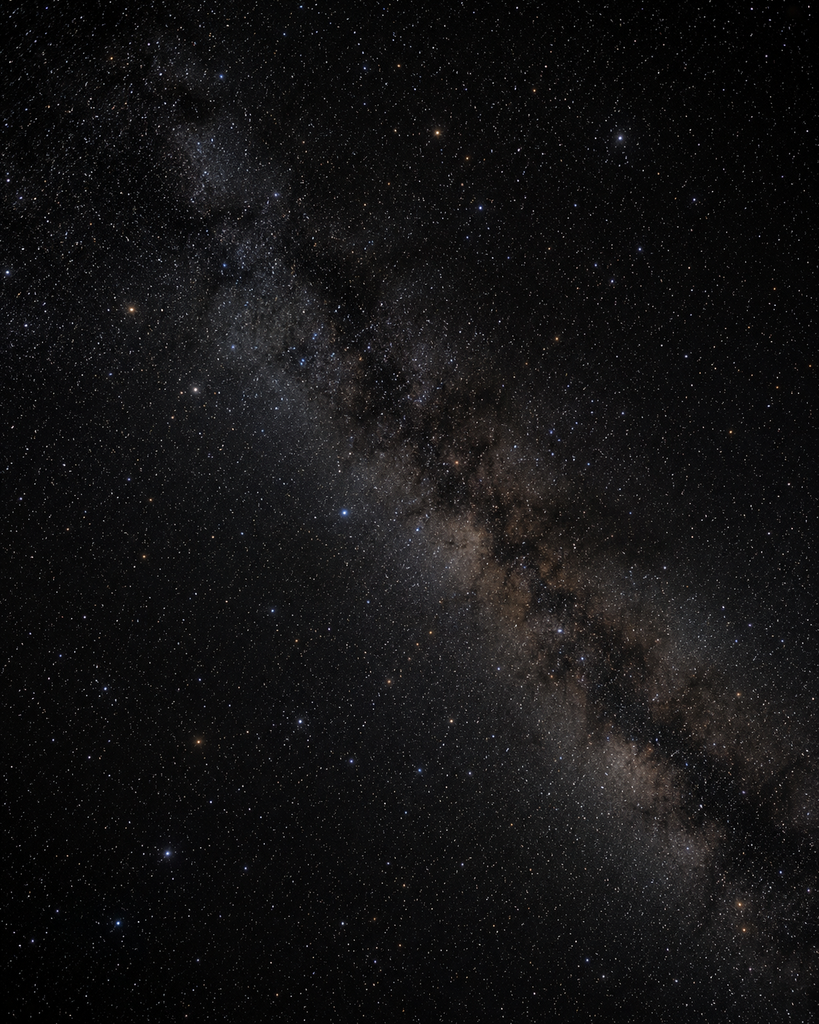
THE WORLD IS BIGGER THAN YOUR FRAME.
We never see the whole world. A fairly obvious statement, really. Even while you’re reading this sentence, quite a lot exists outside your field of view that you’re currently not aware of. Usually, that isn’t a problem. We work with what we have, recognize something familiar in it, and turn it into something we can make sense of.
In fact, that’s happening right now. This could just as well be a book full of hieroglyphs. To someone who cannot read the symbols, they would still all be there: dark shapes on a light background, neatly printed and fairly meaningless. But you don’t see a collection of little lines and curves. You’re reading a text. Symbols become words, words become connections, and chances are they are even creating images in your mind that are printed nowhere on this page.
So the symbols do something to you. But you also do something with the symbols.
A FRAME DOESN’T HAVE TO BE WRONG.
Two bright planets are, first of all, simply two bright planets. Depending on perspective and presentation, however, seen from a distance and reduced to a small section of an image, they can create an entirely different impression. Maybe you see two bright curves against a dark background. Maybe the remarkably long-lived adolescent part of your brain sees something else.
Nothing about the planets has changed. The frame shows what is there. And yet something new emerges.
Not in the image. In you.
We know this outside of space as well. A song can be nothing more than music to one person and send another twenty years back within seconds. The notes are the same. What emerges from them clearly isn’t.
And that makes the frame more interesting than the simple fact that there is more world beyond its edges.
THE EDGE ISN’T ONLY ON THE OUTSIDE.
When we talk about a frame, we tend to think about what is missing: things outside the picture, information we don’t yet have, perspectives we haven’t considered. Taking a step back really can make more visible.
But perhaps the world is bigger than our frame in another way as well.
Perhaps even what we already see contains more possibility than the single meaning that has just emerged for us would suggest. The same symbols can become language or remain hieroglyphs. The same song can be noise, home, memory, or simply three minutes of music. And the same two planets can briefly trigger something decidedly unastronomical without ceasing to be planets for even a second.
Perhaps our frame, then, isn’t only the piece of the world that happens to be in front of us.
Perhaps something of us belongs to it too.
What exactly that might be is another question.